
A Arrangement Of Particles
Particles in a liquid state are not as closely packed and are irregular in their arrangement. Ordered structures occur from the intrinsic nature of the constituent particles to form symmetric patterns that repeat along the principal directions of three-dimensional space in matter.

1 Some Basic Concepts Of Chemistry Textbooks Structure Of Matter Basic Concepts Chemistry Textbook
Liquids and solids are often referred to as condensed phases because the particles are very close together.

A arrangement of particles. The names of the interconversions how they are achieved and the. Kinetic Molecular Theory of Matter Particle Arrangement in Matter Particles in the solid state are closely packed in a regular arrangement known sometimes as a lattice. He proposed that the model of an atom consists of an extranuclear part known as an electron which is located in spherical orbits shell around the.
The motion of individual atoms ions or molecules in a solid is restricted to vibrational motion about a fixed point. Particle Arrangement Learning Objectives. What happens to the arrangement of particles of matter in solid liquid and gas as the temperature decreases.
The smallest group of particles in the material that constitutes this repeating pattern is the. In liquids the particles are closely packed in no fixed pattern spaces between the particles are small but particles can move around each other. There is a lot of space in between the particles and they are constantly moving about.
101 understand the three states of matter in terms of the arrangement movement and energy of the particles. To understand that particles are tiny and make up all matter. Strong forces but weaker than in.
In 1913 a scientist Niels Bohr forwarded his own model of the atom based on the quantum mechanics originally developed by Planck. Liquids are able to flow and move around because their molec. Particles are even more spread apart in gases.
In case you are asking how molecules of liquid are arranged. In crystallography crystal structure is a description of the ordered arrangement of atoms ions or molecules in a crystalline material. They cannot move from their positions.
In solids the particles are closely packed in a regular pattern spaces between the particles are small and particles vibrate in one place. The particle theory of matter is a model that describes the arrangement and movement of particles in a substance. Very strong forces between them.
The three states of matter are solid liquid and gas. There are three main states of matter. The particle model represents particles by small solid spheres.
In gases the particles are much further apart than in solids or liquids. The particles collide with other particles and with the walls of the container. This explains why solids cannot be squeezed into a smaller shape - solids cannot be compressed.
Can move quite fast and slide past each other. Solids have fixed shaped that are hard to break apart because individual particles do not have enough energy to escape individually. In a gas particles are separated.
Solids are ALWAYS in a regular lattice pattern. Closely packed in a regular arrangement. Would see the particles in the solid are packed tightly together.
What is the arrangement of particles in a solid. To be able to explain how the arrangement of particles gives the physical properties associated in a solid liquid and gas. Particles are arranged and move differently in each state of matter.
Answer 1 of 6. Solid liquid and gas - Solids have molecules that are packed together so that they do not move around. In solids molecules ions or atoms are arranged in a definite pattern.
The particles in a solid. Is a model that describes the arrangement and movement of particles. The model can be used to explain the physical properties of solids liquids and gases.
We would also see that the particles in the solid have fixed positions. The model is used to explain the physical properties of solids liquids and gases. Natural Sciences - Solid Liquid and Gas.
Solids are almost completely incompressible and are the densest of the three states of matter. Loosely arranged but still close together. What is the arrangement of particles in matter.
Even at very low temperatures. None of the above. The particles of most solids are packed tightly together in an orderly arrangement.
The molecules are not too far apart so that they are able to move around. Packing arrangement of particles is responsible for different types of solids and their properties. Layers of metal ions surrounded by delocalised electrons B.
The particles can move around and mix with other particles. Closely packed electrons with delocalised ions C. Gas vibrate and move freely at high speeds.
Liquid vibrate move about and slide past each other. It describes the arrangement movement and energy of particles in a substance. Individual particles in liquids and gases have no fixed positions and move chaotically.
102 understand the interconversions between the three states of matter in terms of. The particles in solids vibrate about fixed positions. They are generally in motion not bound to each other but staying in loose contact.
In a solid particles are packed tightly together in a regular pattern. Which one of these describes the arrangement of particles in a metal. The weak cohesive force is overcome when a liquid boils or evaporates.
The model is used to explain the physical properties of solids liquids and gases. This explains why solids keep their shape. Solid vibrate jiggle but generally do not move from place to place.
Solids contain particles that are tightly packed with very little space between particles. Particles in liquids are able to slide past each other or flow to take the shape of their container. Answer 1 of 4.
When it freezes the kinetic energy of the molecules is no longe. Arrangement of Particles in an Atom. Solids - Arrangement of solid particles.
Alternating layers of metal ions and electron D.

A Scheme For Classifying Matter Science Lessons Teaching Chemistry Chemistry

Crystalline Amorphous Solids Chemistry 11th Chemistry Chemistry Crystalline Solid
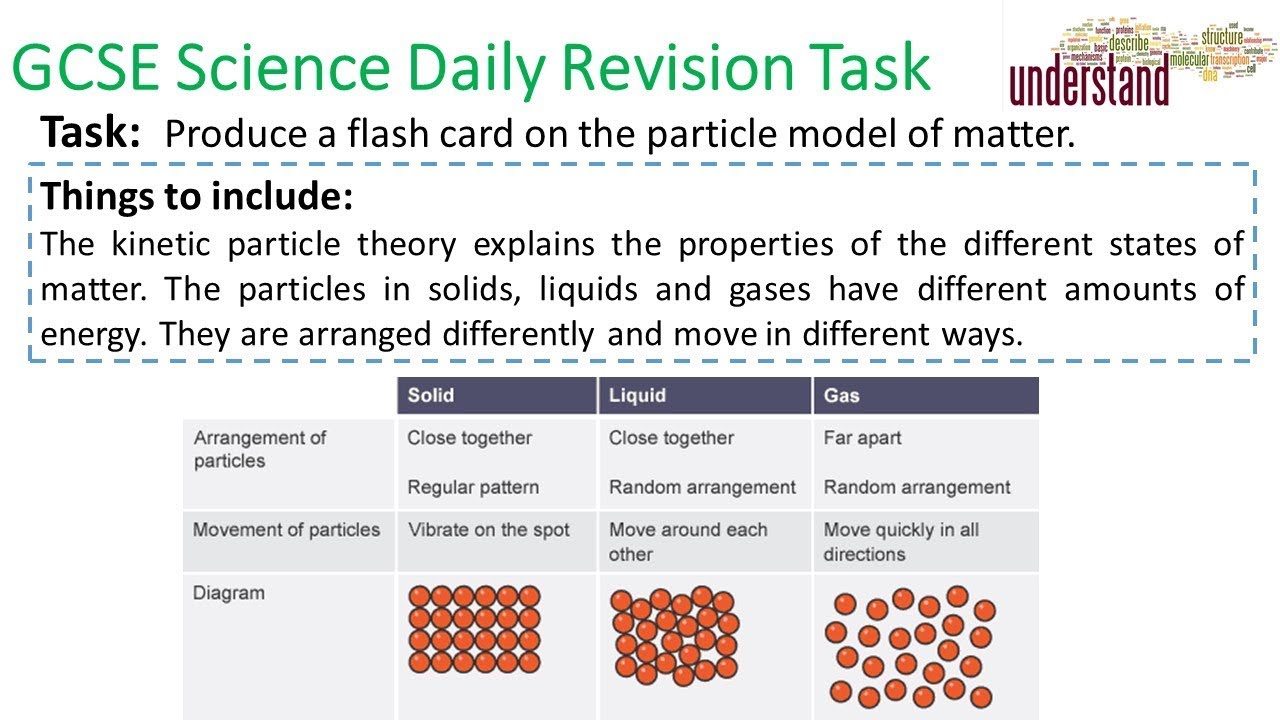
Gcse Science Daily Revision Task 86 State Of Matter Gcse Science Gcse Science Revision Science Daily

8 Kinetic Model Of Matter Content States Of Matter Brownian Motion Kinetic Model Solid Liquid Gas Science Blog Physics Lessons
Soil Structure Is The Arrangement Of Soil Particles Into Small Clumps Called Peds Or Aggregates Soil Particles Sand Silt Cla Soil Texture Soil Soil Layers

Arrangement Of Molecules In The Three States Of Matter States Of Matter Interactive Science Notebook Middle School Science Experiments

Bbc Gcse Chemistry States Of Matter Revision 1 Gcse Chemistry Teaching Chemistry States Of Matter

Learn Solids Liquids And Gases Plasma And Bec States Chemistry Kinetic Theory Chemistry High School Chemistry

Phase Phase In Thermodynamics Chemically And Physically Uniform Or Homogeneous Quantity Of Mat States Of Matter States Of Matter Worksheet Matter Worksheets

The Kinetic Theory Of Matter Matter Science States Of Matter Kinetic Theory

Tales Of Frogs And Cupcakes Solid Liquid And Gas Diy Matter Science Science Lessons Science

Difference Between Atomic Structure And Crystal Structure Comparison Summary Atomic Structure Crystal Structure Crystals

Pin By Katie Mccuddin On Grammar Matter Experiments States Of Matter Whole Brain Teaching

Gcse Science Matter Matter Matter You Matter In 2021 Gcse Science Matter Science Gcse

Posting Komentar untuk "A Arrangement Of Particles"